
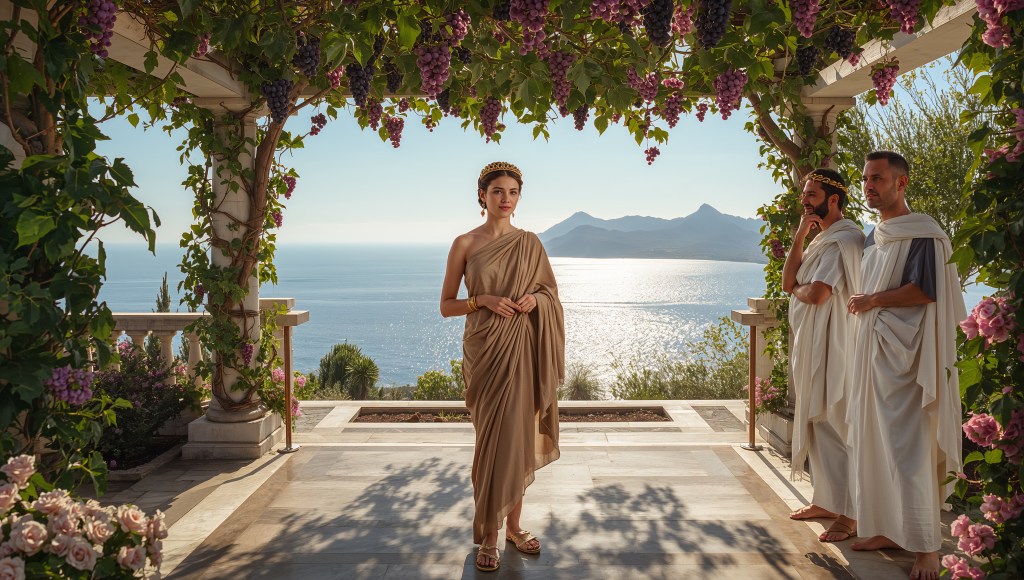
Famous Hetaira: Freedom Built on Intellect
When we hear the phrase famous hetaira, we often imagine beauty or scandal. But in Ancient Greece, this term described something far more powerful. A hetaira was not simply a companion — she was an educated, socially skilled woman who achieved freedom through intellect and ambition, not permission or inherited status.
History tends to simplify the past. It tells us that women had no voice, no choice, no agency. Yet reality was more complex. Even in rigid societies, there were women who found ways to think independently and shape their own destinies.
Life Beyond the Domestic Script
In classical Greek society, most women were expected to remain within the household. Silence was praised. Visibility was discouraged. Public influence belonged to men.
And yet, some women stepped beyond that boundary.
They did not overthrow the system. They navigated it. They entered intellectual circles, attended symposia, engaged in conversations about philosophy, politics, and art. Their presence was intentional.
A hetaira was not defined by rebellion. She was defined by awareness.
Freedom as Strategy, Not Accident
Hetairai were not born powerful. Many began as outsiders — foreigners, freedwomen, or individuals without strong family backing. What they lacked in status, they replaced with skill.
They learned how to:
— read social dynamics,
— communicate with precision,
— understand influence,
— position themselves intelligently.
Their education was practical. It came from experience, mentorship, and participation in elite environments. There were no formal schools. Life itself was the classroom.
Over time, this learning created autonomy.
Freedom was not romantic. It was earned.
Presence That Shifted Conversations
Ancient sources describe how a famous hetaira could transform a room. Not through loudness, but through clarity. Not through aggression, but through wit and insight.
Men initially came to observe.
They stayed to listen.
Figures such as Aspasia or Phryne demonstrate how influence could exist outside official titles. These women did not hold political office, yet they shaped discussions and decisions through proximity and intellect.
They were not ornaments beside power.
They were participants in it.
Individuality Instead of Conformity
There was no uniform model of a hetaira. They were not defined by one appearance or personality type. What united them was independence.
They valued education, rhetoric, and cultural awareness. Beauty played a role, but intelligence amplified it. Attraction grew through conversation, humor, and social intelligence.
In a world structured around fixed female roles, they created flexibility.
That flexibility was their strength.
A Rare Form of Social Mobility
The most striking difference between hetairai and other women of their time was mobility.
They could:
— own property,
— manage finances,
— choose relationships,
— maintain personal independence.
This was rare in the ancient world.
Their autonomy did not erase limitations, but it expanded possibilities. It proved that even within strict systems, there were pathways for those willing to cultivate intellect and ambition.
Why This Story Still Matters
The story of the hetaira is not simply historical. It is symbolic.
She represents a woman who understands her environment, develops her mind, and builds influence through presence and strategy. Her freedom was never handed to her. It was constructed step by step.
That is why the idea remains relevant today.
At BankModels, history is not just a reference — it is inspiration. The legacy of the hetaira reflects timeless values: intellect, confidence, and self-determined presence. And we take genuine pleasure in sharing stories of the past where women shaped their lives through awareness, education, and ambition long before such ideas became part of modern conversation.
 WORLDWIDE
Leave a comment